Posts

Showing posts with the label Techniques

New beading supplies and a new find

Image
A few weeks ago, I went to a Joann Fabric and Craft store for the first time in years, and I found these two items: On the left are some connectors for making eyeglass lanyards, which have recently made my to-do list. One of my aunts used to make them, and back then, I used to think, "I just don't see why anyone would want that." However, now that I need reading glasses myself and realize how often a person has to put them on and take them off, I can see just how practical eyeglass lanyards can be. On the right are some clasps I found on clearance. I'm not sure how they work, or even if they work, since I haven't opened the package yet, but hey, they were on sale. On my to-try list is this item I found while flipping through a Fire Mountain Gems catalog that came in the mail, Tuesday: I am intrigued by this. I can't wear earrings for more than a day because they always irritate my ear lobes. But if this works as promised, I could wear my own e...

Beading Term: Bead Stopper

Bead stoppers are tightly wound metal springs with loops on each end. Beaders thread the end of their stringing material through the stoppers to keep beads from sliding off of the string. As a cheaper alternative, some beaders (myself included) just tie a bead that stands out from the ones they're using in their project to the end of the thread. This is called a stop bead.

Couching

I bought some deerskin several years ago with big plans to learn couching. I have several books that contain patterns, but I have yet to give it a try. About five years ago, I went to the Red Earth Festival in Oklahoma City. The event has tons of arts and crafts booths with the biggest variety of arts I've ever seen. One of the crafts vendors had some deerskin purses with couched beaded flowers and other images on the outside. I would've loved to buy one, but they were priced beyond what I was able to spend. Ever since, I've thought about learning to do the same. I bought some deerskin off of eBay (and probably paid way too much for it), but I have yet to learn to make a purse or to couch. Perhaps after the festival in December has passed, I'll make the time to practice and learn.

Bead Books on a Budget

For any beaders, myself included, who love to look at bead books but can't afford to buy them, here is a little tip. Many public libraries participate in interlibrary loan, a program through which patrons have access to books that their local library might not carry. I'm not sure how many people are aware of that service; until I worked in libraries myself in my 20s, I had no idea the program existed. My husband didn't know it existed until he met me and I told him about it, and it's really come in handy for both of us because our local library is small, has a rather dated selection of craft books and doesn't get new books in very often. If there's a bead book (or a book on any other topic in which you have an interest) that your local library doesn't have, it's worth the time to ask the staff if you can get it through interlibrary loan. I've worked in three different libraries, all of which offered the service and none of them charged for it...

Tutorial Monday: Peyote Stitch -- Even Count

Image
Peyote stitch arranges the beads in a brick-like pattern. Its rows (in all patterns I've seen) are spaced a half-bead apart. Therefore, the rows look like this: Before we begin, here are a few notes about this tutorial: The steps for an even-count and odd-count peyote stitch vary slightly, so this week, we'll cover the even-count version, which is simpler, and next week, we'll cover the odd count. Like my other tutorials, this mentions working from left to right, with left being the side of the beadwork that contains the first bead on the string. For clarity, beads in row 1 will be labeled 1a, 1b and 1c. Beads in row 2 will be labeled 2a, 2b and 2c. 1. String an even number of beads onto your threading material. (In these illustrations, we will use six beads, which will make three beads per row.) 2. Pick up one bead. This will be 3c. Pass the needle from right to left through bead 2c. 3. Pick up one bead. This will be 3b. Pass the needle from r...

Tutorial Monday: The Square Stitch (Flat)

Image
Square stitch beadwork looks strikingly similar to beadwork made on a loom. For me, working with a loom is faster, but I like the square stitch, too, because you don’t have to work your warp threads (the strings that run the length of the loom) back into your work to hide them when you’re done. The length of this tutorial might look a little daunting, but the steps are really quite simple. It’s this long because I wanted to show what to do to add a row twice. A few notes about this tutorial: This is written with a row being four-beads long. All steps, however, are the same for any flat, rectangular work made with the square stitch no matter how long your work is. For clarity, rows are labeled 1, 2 and 3, and beads within each row are labeled a, b, c and d. Therefore, row 1 will consist of beads 1a, 1b, 1c and 1d. Also for clarity, bead 1a is the first bead on the string, 1b the second, etc., and rows are read from left to right. (For even rows, the first bead on the string will...

Single-Needle Ladder Stitch

Image
Unlike the two-needle method , this ladder stitch technique will leave a single length of string, which can be used to add beads in brick or herringbone stitch. For this example, we’ll make a four-bead ladder, but the technique is the same for shorter and longer projects. Note: I indicate placing your work to your left only to make these instructions as clear as possible. Quite often, I’ve got my beadwork all over the place as I’m stitching, so please don’t feel locked into holding yours exactly as written. What matters is that you stitch in the correct direction for whatever placement you have your work. Step 1 Attach a stop bead to your stringing material. Place it to your left. Step 2 Pick up four beads with your needle, and slide them within an inch of the stop bead. (For clarity, let’s number the beads 1 through 4 from left to right.) Step 3 Pass the needle from left to right through bead No. 3. Pull the string tight. The barrels of beads No. 3 and 4 shoul...

Ladder Stitch -- Method 1

Image
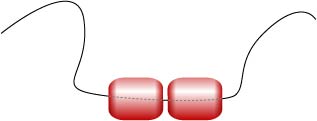
This tutorial creates a single row of beads; however, depending on the style of bead and the stringing material you use, you can create a ladder with beads two, three, four, five or more beads wide. If you're stringing material is wire, no needles are needed. However, if you are using nymo thread, silamide thread or any other material with a threadlike flexibility, you'll need two needles, one for each end of thread. 1. Slide two beads to the center of your string.   2. Position the beads so that their barrels are side by side and one end of string exits through the top of each bead. 3. Thread the end of the string on your left down through the top of the bead on your right. 4. Pull the end of string all the way through. One bead should now be tied to the other, with both ends of string exiting a single bead on opposite sides. 5. Add a new bead onto either end of string, and slide the bead all the way down to the other two. 6. Pick up the ot...

Beading Techniques

Check back often. More beading how-tos will be added in future posts. Stop Beads Ladder Stitch -- Method 1: Use to create two equal lengths of string coming out of the ladder. This is ideal for projects in which the ladder is not on the edge of the project. Single-Needle Ladder Stitch:  Use to create a single length of string coming from the ladder. This technique is ideal for projects in which the ladder is at the edge of the project. Square Stitch : Use in projects that look like loomwork. Peyote Stitch--Even Count. Peyote Stitch--Odd Count.

Stop Beads

Beginning with this post, I will occasionally add some beading how-tos. Here's a very basic technique. Stop beads keep the beads of a project from sliding off. I typically choose a bead that is larger than the ones within the project so that it stands out. To secure a stop bead: Thread your needle. String one bead onto your thread or other stringing material. Slide it within an inch or two of the opposite end of the thread. Pass the thread through the bead again so that the thread forms a complete loop around the bead, then pass it through again. Pull the thread tight so that the bead is secure.